Wednesday, February 13, 2013
Stop Motion Animation
This music video is made using cut-out pictures of people and objects, the camera is moving progressively backward away from the advancing cut outs. Pretty rad!

Monday, February 4, 2013
Len Lye's Colour Box
So I read a little bit about Len Lye and his sculptural and animation work. His film Colour Box is pretty much bright colors and pretty dancing music synced up. The diversity of the color application is important in this film, because some of it seems to run across the screen. For an artist in the 1930s this is impressive stuff. I wish I could've found a better quality version of the film for these screen shots. I enjoyed the way he shuffled the images all around and they didn't just flow in one direction.


Monday, January 28, 2013
Camera-less Film: Scratch Animation
I really enjoyed making a scratch film in animation class. It was unusual to be able to hold the film in my hands and look over the whole thing piece by tiny piece before sending it up onto the screen. I was especially pleased by scratching away some parts and removing others with bleach, and then putting colored markers to use in their place.
This is a sample animation I found which uses similar techniques to those we considered in class, but this whole 3 minute animation was done by a single person. They must have dedicated quite a bit of time to scratching away at that film. I would have gotten frustrated (probably) but their work paid off with smooth animation that uses line and color effectively to produce pleasant moving shapes. My own animation was totally random, so I appreciate the careful thought that went into this one.
This is a sample animation I found which uses similar techniques to those we considered in class, but this whole 3 minute animation was done by a single person. They must have dedicated quite a bit of time to scratching away at that film. I would have gotten frustrated (probably) but their work paid off with smooth animation that uses line and color effectively to produce pleasant moving shapes. My own animation was totally random, so I appreciate the careful thought that went into this one.
Wednesday, January 23, 2013
Edward Muybridge Animations : Early Film
Tuesday, January 22, 2013
The 2000-Page Flipbook
This flip-book posted to YouTube by Ben Zurawski is a compilation of many individual flip-book style animations, totaling 2000 pages. Zurawski makes custom flip-books - his youtube channel "TheFlippist"advertises flipbooks as gifts for all occasions. It's interesting that Zurawski has managed to monetize this sort of personal "hand-held animation," he even has an Etsy site where he sells commissions. I like that there is a great variety of subjects and jokes, as many as can be imagined. Although the medium seems limited, it's only limitation is how far one is willing to take it. Zurawski seems to have grasped the horns of the animation bull. I chose this animation because it represents an amalgamation of Zurawski's styles of animation. Although some parts of this are not exactly work safe, I thought it was silly and funny enough to include.
I really like the idea of flip-books as gifts, because they're neat little oddities that can amuse anyone. I'm not sure I could do what Zurawski does because drawing all those tiny panels makes my hands hurt.
Monday, October 1, 2012
Judith Scott and Outsider Art

Early on in our Criticism Class I mentioned "outsider art" as being difficult to criticize - without really knowing all that much about it, I knew that art created by untrained individuals would necessarily incite different sorts of criticism than art created within the established structures of society. I've since done a bit more research, and discovered that I genuinely like the weirdness of these outsider artists.
There's something really compelling about just feeling the urge to make something, an urge so strong you would just MAKE, regardless of convention. And I'm not alone: the re-purposing of ordinary objects that's seen in many outsider's work was adopted into the mainstream by modernists like Marcel Duchamp. Even Picasso drew inspiration from the untrained eyes of children for his work. The involvement of these highly influential and controversial artists with the "domestication" of outsider art only makes it more intriguing. But I digress! Let's move on to what I really want to talk about: Judith Scott.
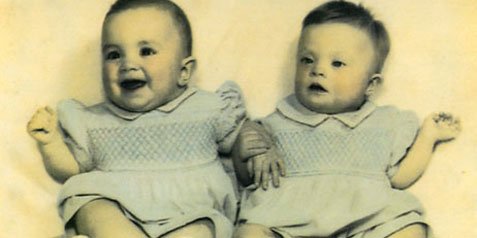

In 1986, the adult Joyce found Judith and took her to live with her family in California, against the advice of her mother. Judith was able to enroll in adult education classes at the Creative Growth Art Center in Oakland. After almost two years of exhibiting little interest in painting or drawing, Judith observed a demonstration of fiber art by visiting artist Sylvia Seventy, and soon after began creating her own unique body of work.
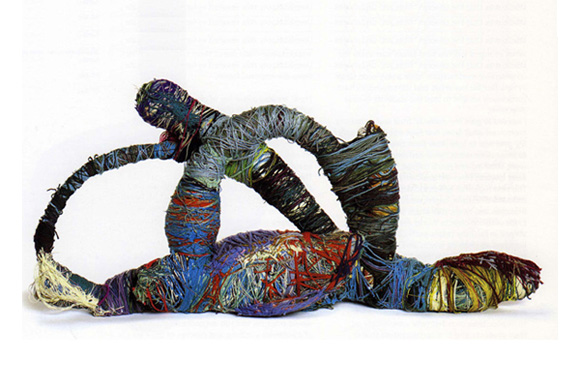
Most of Judith's works are composed of found objects wrapped in yarn or other cords. She chose all her own materials, and in 18 years of work never repeated a color scheme or shape. The most common themes within her work are pairs, most likely relating to her life as a twin, and poles, which sometimes rise out of magnificent colorful lumps.

Her figures have been compared to cocoons or body parts. I find that their frenetic use of color recalls the static of a television screen, while the yarn that covers most of the composition gives an impression of softness to shapes that may otherwise seem rough and unfriendly.

Theres is a definite vision in Judith's diverse sculptural work. Each shape contains an embedded object which Judith found to be of some significance. The wrapping of these objects till they are invisible seems almost shamanistic, ritualized. The big, colorful forms that were created in this process may be impressions of isolation, or armor, or simply change. Maybe they are an expression of the artists desire to keep things safe, or contained.
Judith was never able to explain her work, but it's mystery only adds to it's expressive power.
Monday, September 10, 2012
Allow me to geek out for a moment...
 It's time for another of these blog entries, and I've decided to give homage to another artist whose work has inspired me from the time I was young: Hayao Miyazaki. Well known as the writer and director of films such as Howl's Moving Castle, Spirited Away, and Princess Mononoke, Miyazaki's work may not seem to fall under the umbrella of "fine art." The success of his films, both in Japan and abroad has earned him comparisons to Walt Disney, whose success in producing family-friendly animation helped build an empire.
 Despite these comparisons, Miyazaki's works display greater emotional and psychological depth than any Disney film. I have been impressed by Miyazaki's beatifully hand-drawn animation and painted scenery since my first exposure to his work, the film Nausicaä of the Valley of the Wind. This film showed me that animation didn't have to be the "kid stuff" my parents so frequently complained about. It had everything: awesome scenery, epic adventure, environmentalism... and a strong female lead. That really caught my attention. Generally, females in film aren't very strong or leader-ly. They end up being dependent on the men to save them no matter how capable they seem, or the film is about their quest to "get the guy." This film didn't fall into either of these holes.

I was so impressed that I sought out the rest of Miyazaki's films, and I have not yet been disappointed by his work. From a literary perspective, the stories in his films are exceptional for the depth of feeling behind each characters actions. In most of his films, there is no "bad guy" whose purpose in the story is simply to be evil. The antagonists in his films are often ambiguous, revealing a moral grey area that the protagonist has to navigate. This is best illustrated in Spirited Away, which won the Academy Award for Best Animated Feature at the 75th Academy Awards.

Chihiro, the main character, encounters many scary beings during her time in the bath house of the spirits, but learns that not all of them are out to get her. Some of the scariest ones end up helping her in the end. Her adventures in the spirit world follow the classic coming-of-age model, as she learns to have confidence in herself and her actions. All these story details are well and good, but this is supposed to be an art blog! What about the art?? One characteristic of Miyazaki's films that appeals to me is his use of watercolors. Landscapes and environments are bright and beautifully painted. Equally impressive is Miyazaki's dedication to traditional hand-drawn animation. Since many of the most popular animated films of this era are completely computer-animated, it's heartening to me as a lover of beautiful animation to know that purists like Miyazaki can succeed and even thrive.
Subscribe to:
Posts (Atom)